Solutions Teams Evaluate Instead of Adalo for No-Code App Building With Backend Capabilities
No-code development has evolved from a scrappy prototyping shortcut into a serious strategy for building scalable applications with robust backend functionality. While Adalo is often one of the first platforms teams explore, it is far from the only option—and in some cases, not the best fit. Organizations looking for deeper backend logic, better scalability, more flexible databases, or stronger integrations frequently evaluate alternatives that better align with their technical and business goals.
TLDR: Many teams move beyond Adalo when they need stronger backend logic, scalability, or flexibility. Platforms like Bubble, Glide, OutSystems, FlutterFlow, Backendless, and Xano each offer distinct advantages depending on complexity and growth goals. Choosing the right solution depends on how much customization, control, and performance your app requires. The “best” tool is the one that aligns with your long-term product roadmap—not just your MVP needs.
Below is an in-depth breakdown of the top no-code and low-code alternatives teams frequently evaluate instead of Adalo—especially when backend capabilities are a priority.
Why Teams Look Beyond Adalo
Table of Contents
Adalo is often praised for its mobile-first interface and beginner-friendly builder. However, teams commonly seek alternatives when they encounter:
- Limited backend logic flexibility
- Performance constraints at scale
- Database complexity limitations
- Advanced API workflow needs
- Custom authentication requirements
When projects grow from MVP to production-level products, those constraints can become critical. That’s when teams begin exploring more backend-focused no-code ecosystems.
1. Bubble
Best for complex web applications with custom backend workflows.
Bubble remains one of the strongest all-in-one no-code platforms for full-stack development. Unlike simpler builders, Bubble offers:
- Custom database structuring
- Advanced backend workflows
- API connector for third-party integrations
- Conditional logic and automation
- Plugin ecosystem
Where Bubble truly shines is backend logic. Developers can create scheduled workflows, trigger database events, and design relational data structures comparable to traditional development frameworks.
Why teams choose it over Adalo:
- Greater backend customization
- More control over data relationships
- Stronger scaling capabilities
- Wider community and plugin marketplace
However, Bubble has a steeper learning curve. Teams must invest time in architecture planning to prevent performance bottlenecks.
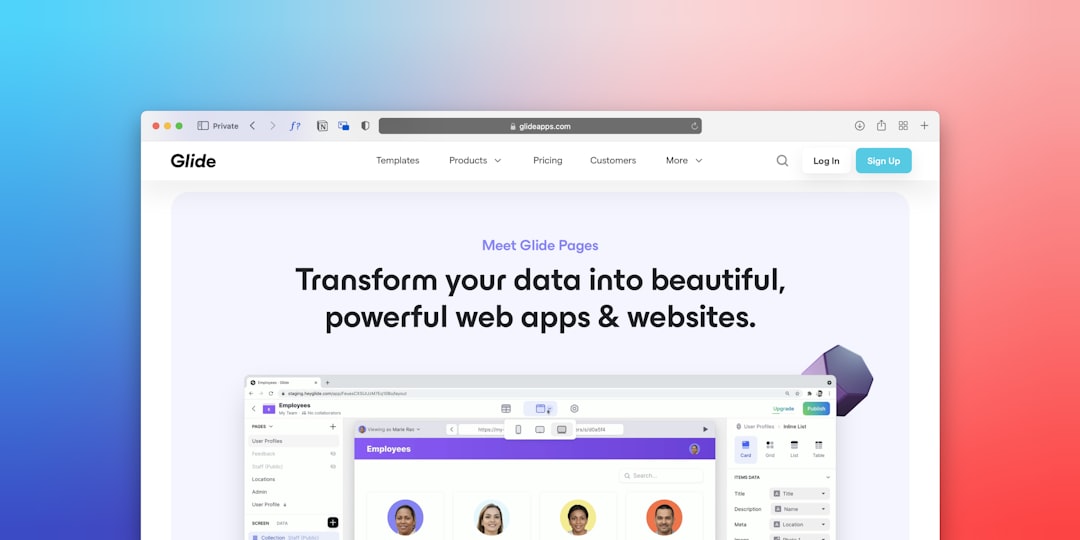
2. Glide
Best for data-driven internal tools and client portals.
Glide began as a spreadsheet-based app builder but has matured into a powerful no-code platform backed by structured databases. It’s especially favored for:
- Internal business dashboards
- CRM systems
- Field operations apps
- Membership platforms
While Glide doesn’t offer backend control at the level of Bubble, it provides robust data relations and computed columns that simulate backend logic without needing complex workflows.
Why teams evaluate it instead of Adalo:
- Simpler database management
- Faster deployment cycles
- Strong performance on Progressive Web Apps
- Structured data modeling
For businesses focused on operational efficiency rather than consumer-scale mobile apps, Glide can be a cleaner and more maintainable solution.
3. Backendless
Best for teams prioritizing backend-as-a-service with visual logic.
Backendless places backend power at the center. Instead of starting with design screens, teams begin with:
- Visual database modeling
- API services
- User management systems
- Event-driven logic flows
- Cloud function deployment
Its visual logic builder allows teams to construct backend processes similar to traditional backend frameworks—without writing raw code.
Why it’s evaluated over Adalo:
- Stronger role-based access control
- Event-driven architecture
- Scalable cloud hosting
- Separation between frontend and backend layers
Backendless is often paired with frontend builders like FlutterFlow or custom web interfaces, giving teams modular flexibility.

4. Xano
Best for scalable backend APIs with no-code logic automation.
Xano focuses purely on backend infrastructure. It offers:
- Scalable PostgreSQL databases
- No-code API builder
- Complex business logic automation
- Secure authentication management
- High performance hosting
Unlike Adalo’s built-in backend, Xano is designed for serious scaling. Many teams pair Xano with frontend builders like Webflow, FlutterFlow, or custom React apps.
Why teams prefer it:
- True API-first architecture
- Advanced logic branching
- Enterprise-ready scaling
- Greater database control
If data complexity and scaling are your primary concerns, Xano becomes an attractive option.
5. FlutterFlow
Best for mobile apps requiring custom code extensibility.
FlutterFlow blends no-code speed with developer flexibility. It allows teams to:
- Visually design Flutter-based apps
- Integrate Firebase for backend support
- Export clean source code
- Implement custom Dart code when needed
For startups planning to transition from no-code MVP to fully coded infrastructure, code export is a game changer.
Why it competes with Adalo:
- More robust mobile performance
- Native app flexibility
- Custom code injection
- Stronger developer handoff potential
Instead of being locked into a proprietary ecosystem, teams maintain future portability.
6. OutSystems
Best for enterprise-grade internal and customer applications.
OutSystems occupies the high end of low-code development. It offers:
- Enterprise deployment tools
- Advanced security governance
- Scalable server infrastructure
- Integration with legacy systems
- AI-assisted development features
Unlike Adalo, OutSystems is not targeted at solo founders. It’s built for enterprises managing compliance, scaling infrastructure, and large user bases.
Why companies evaluate it:
- Enterprise-grade DevOps
- Strong governance frameworks
- Complex backend orchestration
- Deep integration with existing tech stacks
Comparison Chart
| Platform | Backend Strength | Scalability | Code Export | Best For |
|---|---|---|---|---|
| Bubble | High | Moderate to High | No | Complex web apps |
| Glide | Moderate | Moderate | No | Internal tools |
| Backendless | Very High | High | Limited | Backend centric builds |
| Xano | Very High | Very High | API based | Scalable backend APIs |
| FlutterFlow | High with Firebase | High | Yes | Mobile apps |
| OutSystems | Enterprise Grade | Enterprise Grade | Limited | Large organizations |
How Teams Decide Which Platform Fits
Choosing a platform isn’t just about features—it’s about alignment with strategy. Teams typically evaluate:
- Projected user growth
- Database complexity
- Integration requirements
- Security compliance needs
- Budget constraints
For example:
- A startup building a marketplace may lean toward Bubble or Xano.
- An operations-heavy company creating internal dashboards may pick Glide.
- A mobile-first consumer product might benefit from FlutterFlow.
- An enterprise modernizing legacy systems may require OutSystems.

The Key Takeaway
Adalo remains a capable no-code tool, particularly for quickly launching mobile MVPs. But as applications grow in complexity, backend control becomes increasingly critical. That’s when platforms like Bubble, Xano, Backendless, FlutterFlow, Glide, and OutSystems enter serious consideration.
The no-code ecosystem is no longer about “simple vs. advanced.” It’s about selecting the right level of abstraction for your needs. Some teams want full backend control. Others want speed and simplicity. Many aim for a hybrid approach that combines visual building with scalable infrastructure.
The smartest move isn’t choosing the most powerful platform—it’s choosing the one that aligns with where your product will be 18 to 36 months from now.
Because in no-code development, backend capabilities aren’t just technical considerations—they’re strategic ones.